TRAINING MATERIALS

Training Materials

Core reference documents for standardized cancer registry data collection, operating procedures, and Setu platform use under OSPBCR.

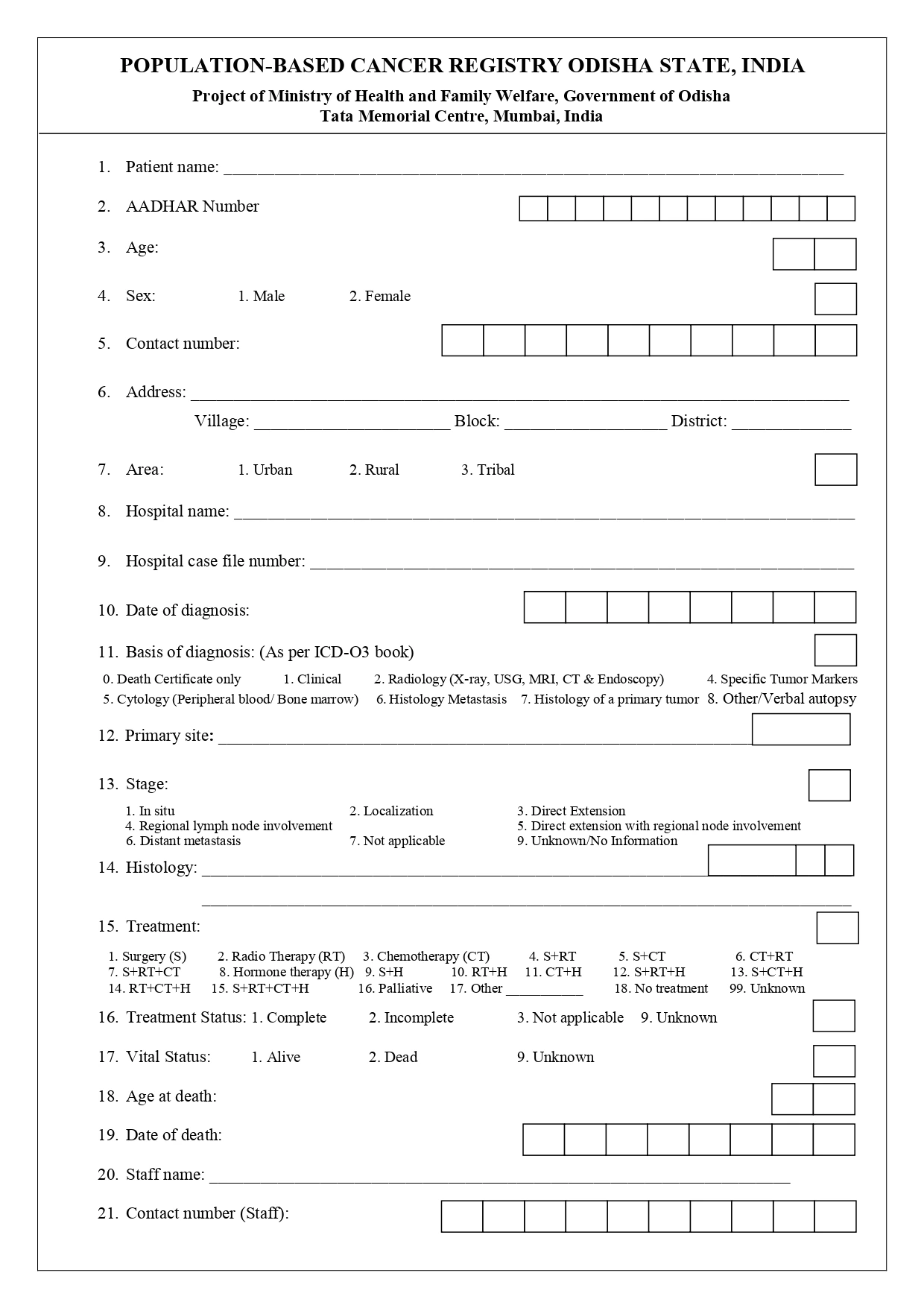
PBCR Odisha_Proforma

PBCR Odisha Proforma PDF preview
Patient Information Form

PBCR Odisha_Proforma

The Odisha State Population Based Cancer Registry (OSPBCR) has developed a standardized Patient Information Form to facilitate systematic collection of cancer-related data across the state. The form serves as the primary tool for recording demographic, clinical, diagnostic, treatment, and follow-up information required for population-based cancer registration.

The form captures essential patient details, including demographic characteristics, contact information, residential location, hospital details, and Aadhaar number to support accurate identification and follow-up. Clinical information collected includes the date and basis of diagnosis, primary site of cancer, stage at diagnosis, histological findings, and ICD-O-3-based classification to ensure standardized reporting.

Comprehensive information on cancer treatment, including the type of treatment received, treatment status, and combinations of therapeutic modalities, is documented to facilitate analysis of treatment patterns and outcomes. The form also records vital status, age and date of death where applicable, enabling long-term patient follow-up and survival analysis.

The standardized data collection format supports uniform reporting across participating healthcare facilities, improves data quality and completeness, and strengthens the accuracy of cancer incidence, treatment, and survival estimates. It provides the foundation for evidence-based cancer surveillance, research, programme planning, and policy development under the Odisha State Population Based Cancer Registry.
Odisha PBCR SOP

Odisha PBCR SOP PDF preview
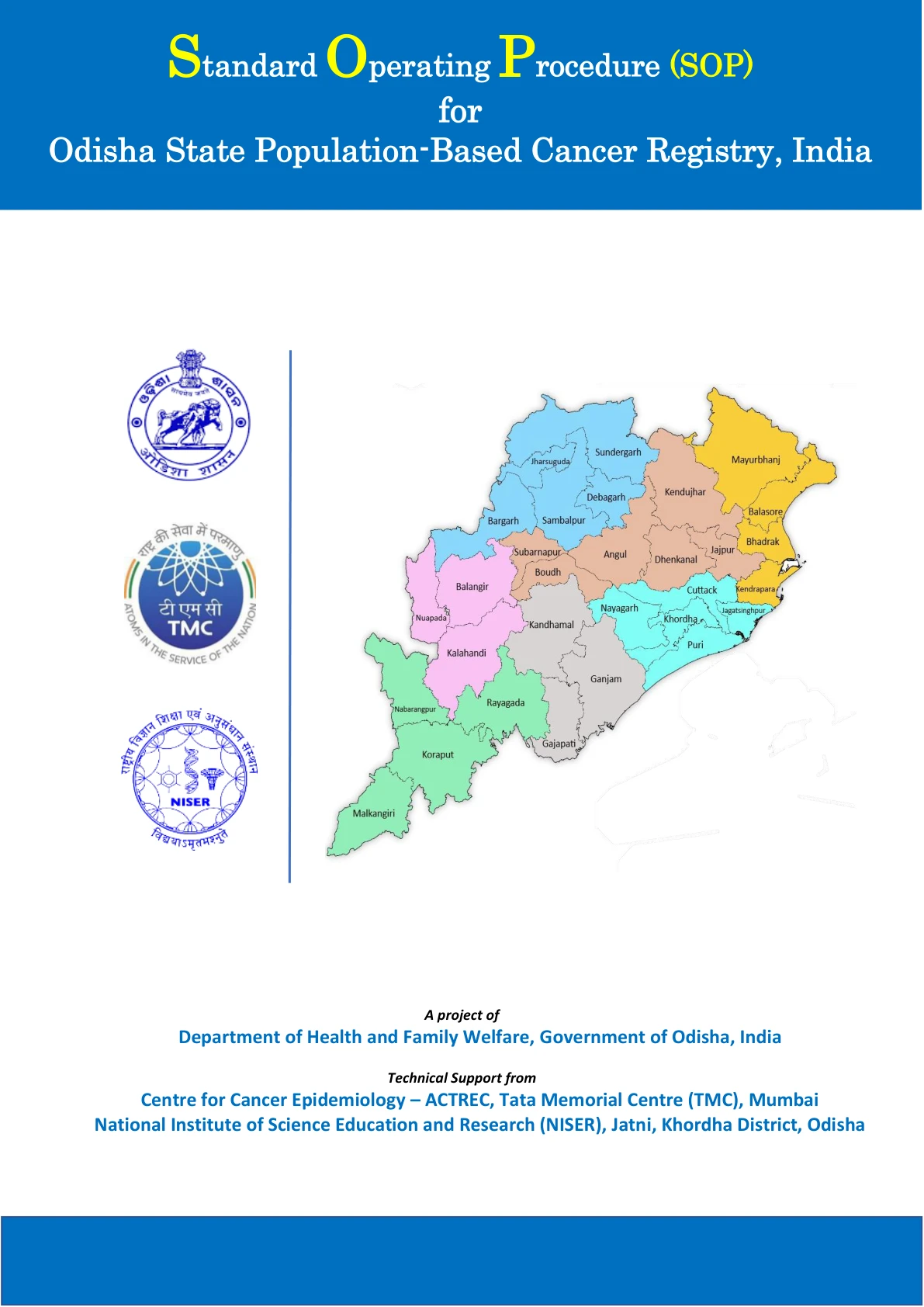
Standard Operating Procedure

Odisha PBCR SOP

The Standard Operating Procedure (SOP) has been developed to provide uniform guidelines for the implementation of the Odisha State Population Based Cancer Registry (OSPBCR). The registry is an initiative of the Department of Health and Family Welfare, Government of Odisha, with technical support from Tata Memorial Centre (TMC), Mumbai, and the National Institute of Science Education and Research (NISER), Jatni, Odisha.

The SOP serves as a reference manual for all personnel involved in cancer registration across the thirty districts of Odisha, ensuring standardized procedures for data collection, case abstraction, coding, and reporting. It aims to maintain high-quality, complete, and consistent cancer registry data across all participating centres.

Registry data collection and abstraction are carried out using the web-based Setu application, which incorporates a digitized version of the standardized registry proforma. The one-page proforma has been designed to capture essential variables that are routinely available during data collection, thereby promoting efficient and accurate reporting.

The manual provides detailed guidance on each data variable collected by the registry and supports registry staff in maintaining uniform data recording practices. Users are encouraged to study the SOP thoroughly before commencing registry activities and to seek guidance from supervisors and Tata Memorial Centre experts whenever technical clarification or operational support is required.

Setu User Manual

Setu User Manual PDF preview
Setu Platform Guide

Setu User Manual

The Odisha State Population-Based Cancer Registry (OSPBCR) is an initiative of the Department of Health and Family Welfare, Government of Odisha, established to systematically collect and manage cancer data across the state. The registry aims to strengthen cancer surveillance and support evidence-based planning for cancer prevention and control.

The Setu web-based application has been developed as the official data management platform for the OSPBCR. It facilitates standardized collection, storage, and management of cancer registry data, ensuring uniform reporting and improved data quality across participating institutions.

All cancer-treating hospitals, District Headquarters Hospitals (DHHs), Primary Health Centres (PHCs), and other healthcare facilities involved in the diagnosis and treatment of cancer patients in Odisha are responsible for entering patient information into the Setu platform. This coordinated reporting mechanism supports comprehensive statewide cancer registration and strengthens the registry's ability to generate reliable estimates of the cancer burden.

International Classification of Diseases for Oncology (ICD-O-3)

International Classification of Diseases for Oncology (ICD-O-3) PDF preview
WHO Oncology Classification

International Classification of Diseases for Oncology, Third Edition, First Revision

The International Classification of Diseases for Oncology, Third Edition (ICD-O-3), is the World Health Organization's standard tool for coding neoplasm diagnoses in tumour and cancer registries and in pathology laboratories. It supports consistent cancer registration and makes data comparable across institutions and populations.

ICD-O uses a dual classification system. The topography code identifies the anatomical site where a neoplasm originated, while the morphology code describes the tumour's cell type and biological behaviour. A separate code is also provided for histological grading or differentiation.

Published by WHO in 2013, the first revision retained the existing topography codes and reviewed and updated morphology terms and codes to improve diagnostic precision and prognostic value. It is an essential reference for accurate, standardized cancer data collection, analysis, and reporting.

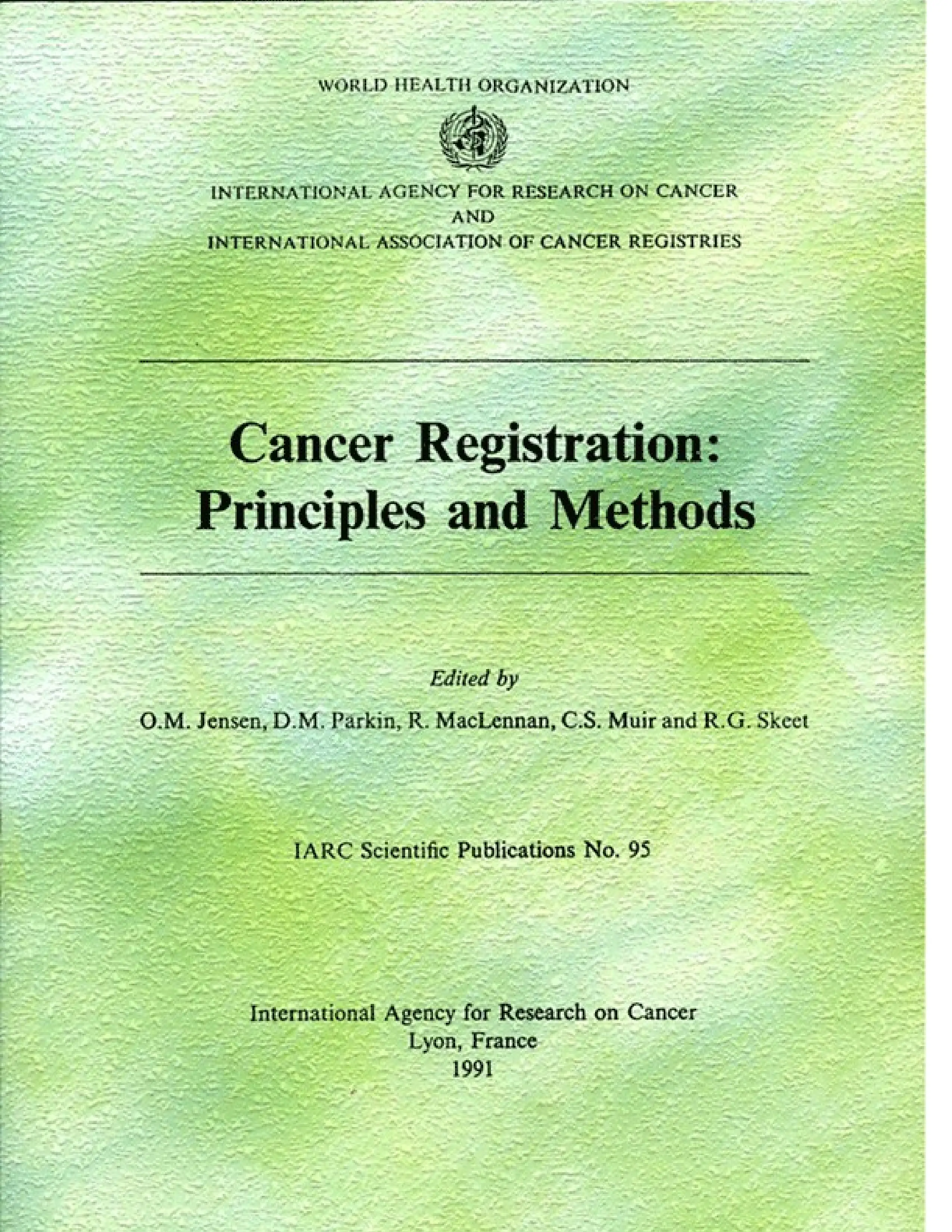
Cancer Registration: Principles and Methods

Cancer Registration: Principles and Methods PDF preview
IARC Scientific Publication No. 95

Cancer Registration: Principles and Methods

Cancer registries play a central role in cancer control by continuously collecting, maintaining, analysing, and interpreting information about cancer cases in a defined population. High-quality registry data reveal cancer incidence and trends, support research into cancer causes, and guide the planning and evaluation of prevention, diagnosis, treatment, and other health services.

Developed through collaboration between the International Agency for Research on Cancer and the International Association of Cancer Registries, this publication provides practical guidance on all aspects of cancer registration. It emphasizes population-based, computer-supported registration, complete case ascertainment, concise high-quality data, standardized definitions, and an internationally comparable core set of data items.

The volume also explains the supportive role of hospital-based registries in patient follow-up, clinical research, and service evaluation. Its uniform operational methods are intended to strengthen existing registries and encourage the establishment of new registries, particularly where the incidence and characteristics of cancer remain insufficiently documented.